

Design thinking in product marketing helps brands understand customers better and create solutions that fit real needs. It uses human-centered design, empathy mapping, and customer journey insights to guide every decision. Instead of depending only on traditional market research insights, teams focus on real problems and simple, creative problem-solving.
This approach improves user-centric innovation and makes the product development process more effective. It supports better user experience design, stronger value proposition strategy, and a clearer path to product-market fit. With tools like rapid prototyping, iterative testing, and real user feedback, marketers can build products that connect with people more naturally.
In this blog, you will learn how design thinking supports product marketing, why brands use it, and how you can apply these methods to improve your next launch or strategy.
What is Design Thinking?
Design thinking is a user-centered approach that focuses on real people and real problems. It uses customer insights, simple problem-solving, and continuous learning to create better ideas. Unlike traditional methods, it is flexible and iterative. This means teams can explore many directions, test quickly, and improve their ideas step by step.
Key Phases of Design Thinking
1. Empathize – Learn about the user’s needs, behaviors, and challenges. This helps you understand their real problems.
2. Define – Clearly state the main problem you want to solve based on what you learned.
3. Ideate – Brainstorm many creative ideas without judging them.
4. Prototype – Create simple versions of your ideas to see how they might work.
5. Test – Get feedback from users, improve your idea, and repeat the process if needed.
Why It Matters in Product Marketing
Design thinking is very useful in product marketing. It makes sure every message, campaign, and idea is centered on the customer. This leads to better decisions, stronger engagement, and products that fit what people truly want.
Why Use Design Thinking in Product Marketing
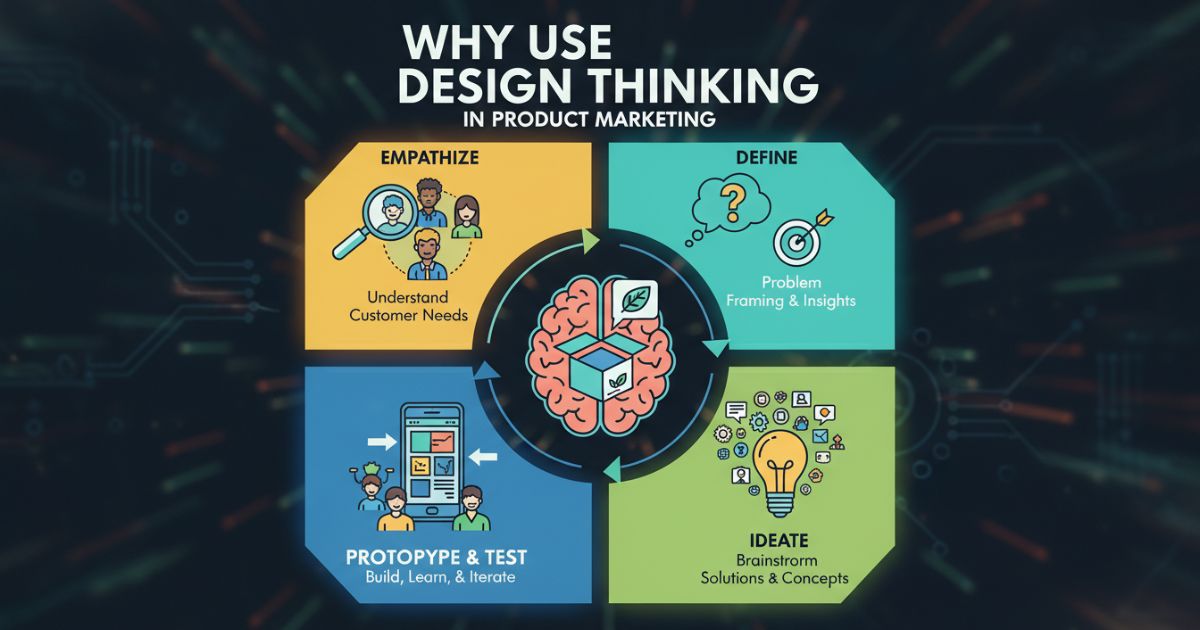
Traditional marketing often depends on assumptions and outdated data. This creates a disconnect between the brand and the real customer. Design thinking solves this issue by using human-centered design, real user insights, and an iterative process that keeps the customer at the center of every decision. This approach helps marketers build strategies that are more relevant, more accurate, and more impactful.
Customer-Centric Strategies
Design thinking encourages a deep understanding of the user. You look closely at their needs, pain points, and goals across the customer journey.
This customer-first approach helps you:
- Build campaigns based on real motivations
- Improve targeting and personalization
- Create a stronger connection with the audience
A customer-centric strategy leads to marketing that feels authentic and valuable.
Innovative Solutions
Design thinking supports creativity and open thinking. During the ideation stage, you explore many possibilities without judgment. This helps you discover:
- Fresh marketing concepts
- New value proposition angles
- Unique ideas that differentiate your brand
By using creative problem-solving, product marketers can break old patterns and find new opportunities in competitive markets.
Agility Through Iteration
Design thinking uses rapid prototyping and iterative testing. This makes your marketing process more flexible and efficient. You can:
- Test ideas quickly
- Validate concepts with users
- Improve the campaign before launch
- Reduce risk and avoid costly mistakes
This agile approach keeps your marketing aligned with real user experience and behavior.
Stronger Messaging
When you empathize with your audience, your messaging becomes clearer and more human. You speak directly to their needs, emotions, and everyday challenges. This leads to:
- Higher engagement
- Better storytelling
- Messaging that feels honest and relatable
- Stronger brand trust
With deeper insights, your marketing communication becomes more powerful and persuasive.
With these benefits, design thinking becomes an essential part of modern product marketing. It helps teams stay innovative, customer-focused, and confident in the ideas they bring to market.
How to Apply Design Thinking to Product Marketing
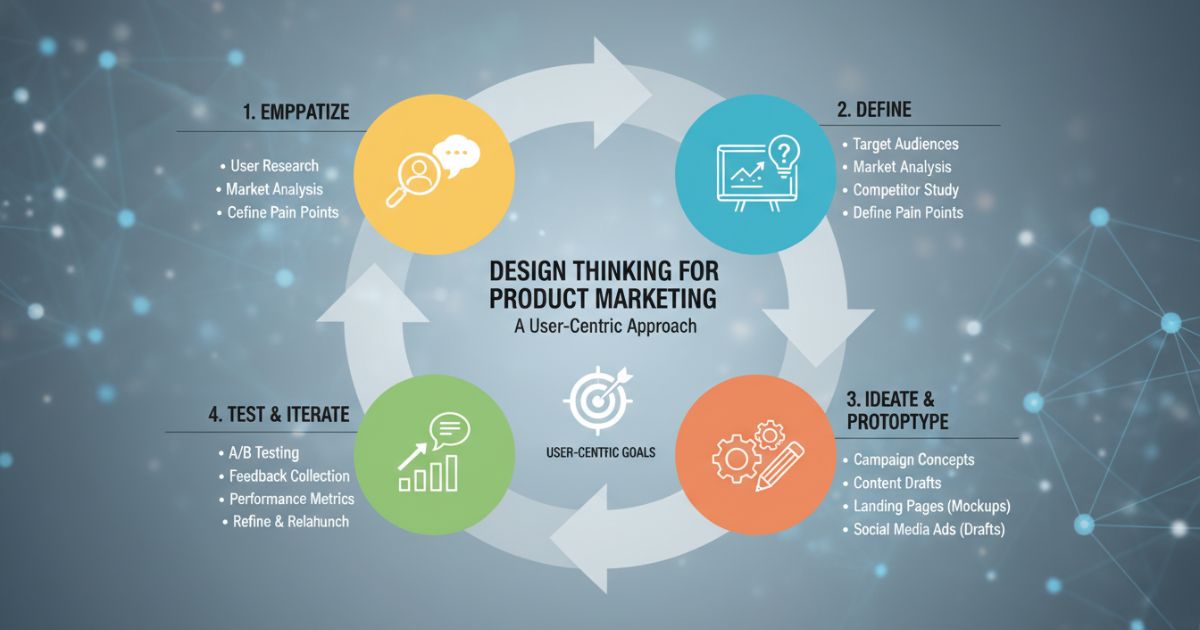
Applying design thinking in product marketing helps you understand users better and create campaigns that match real customer needs. This approach uses human-centered design, customer insights, and iterative problem-solving to make your marketing strategy more effective and meaningful.
1. Start With User Research
Begin by collecting deep user insights. Focus on real behavior, real emotions, and real challenges.
You can use:
- User interviews
- Surveys
- Customer journey mapping
- Competitor analysis
- Social listening
- Market research insights
This research helps you understand the customer experience, identify pain points, and discover what truly matters to your audience.
2. Define the Core Problem
Use your research to identify the exact problem you want to solve.
Keep the problem simple and user-focused.
A strong problem definition helps you improve:
- Messaging clarity
- Value proposition strategy
- Campaign targeting
- Product-market fit
This step ensures your marketing aligns with the real needs of the user, not just internal assumptions.
3. Ideate Creative Solutions
Next, brainstorm as many ideas as possible.
Use open thinking and avoid judging ideas too early.
Explore:
- Messaging variations
- Campaign concepts
- Positioning angles
- Content formats
- Experience improvements
This creative ideation stage helps you find fresh and innovative marketing solutions.
4. Build Simple Marketing Prototypes
Turn your top ideas into quick prototypes.
These prototypes can be:
- Ad drafts
- Landing page wireframes
- Email sequence mockups
- Social media content samples
- Product feature previews
- Messaging scripts
Prototyping lets you test ideas early without heavy time or cost investment.
5. Test Ideas With Real Users
Share your prototypes with actual users or target groups.
Collect feedback to understand:
- What they like
- What feels confusing
- What stands out
- What should be improved
This user feedback loop gives you clear direction and helps you avoid ineffective marketing decisions.
6. Iterate Based on Insights
Use the feedback to refine your idea.
Iterate until the solution feels simple, clear, and valuable.
Iteration improves:
- Message effectiveness
- User experience design
- Campaign performance
- Final conversion rates
This step supports an agile and data-driven marketing process.
7. Launch With Confidence
Once your concept is refined, you can launch your marketing campaign with confidence.
At this stage, you have:
- A user-validated idea
- Strong brand messaging
- Higher relevance to your audience
- Better customer alignment
- A stronger product-market fit
Design thinking ensures your campaign is built on real insights—not assumptions.
Best Practices for Using Design Thinking in Marketing
Using design thinking in marketing works best when teams stay focused on the user and follow a clear, flexible process. These best practices help you apply human-centered design, improve creativity, and build marketing strategies that connect with real people.
1. Start With Real Customer Insights
- Always begin with the customer.
- Use interviews, surveys, and behavioral data to understand what users need.
- Map the customer journey to see where they struggle and what motivates them.
This gives you stronger insights and helps you avoid assumption-based decisions.
2. Encourage a Creative Problem-Solving Mindset
- Create an environment where new ideas are welcome.
- Allow your team to explore different concepts during the ideation stage.
- Avoid judging ideas too early.
This mindset leads to more innovative marketing solutions.
3. Prototype Early and Often
Do not wait for a perfect idea.
Build simple prototypes such as:
- Ad drafts
- Landing page mockups
- Messaging samples
- Social media previews
Early prototypes help you validate ideas fast and reduce risks.
4. Test With Real Users Before Launch
- Testing is essential in design thinking.
- Ask real users for feedback on your messaging, visuals, or campaign flow.
- iterative testing helps you refine ideas and improve accuracy.
5. Collaborate Across Teams
- Design thinking works best when teams collaborate.
- Bring marketers, designers, product teams, sales, and customer support together.
- Different perspectives reveal new insights and create stronger strategies.
6. Focus on User Experience (UX)
- Good marketing is good experience.
- Make sure your campaigns feel clear, simple, and helpful.
- Focus on emotional impact, ease of use, and relevance.
A strong user experience design builds trust and increases engagement.
7. Stay Flexible and Iterative
- Design thinking is not a rigid process.
- Be ready to adjust your ideas as you learn more.
- Use continuous improvement to refine messaging, targeting, and overall strategy.
This keeps your marketing aligned with changing user needs.
8. Document Key Insights and Learnings
- Keep a simple record of what you learned during research, testing, and iteration.
- This helps your team stay aligned.
It also makes future marketing projects faster and more effective.
9. Always Put the User First
- Every decision should support the user
- Whether you’re crafting a message, designing a landing page, or planning a product launch—focus on solving a real user problem.
This leads to stronger relevance and better product-market fit.
Examples of Design Thinking in Product Marketing
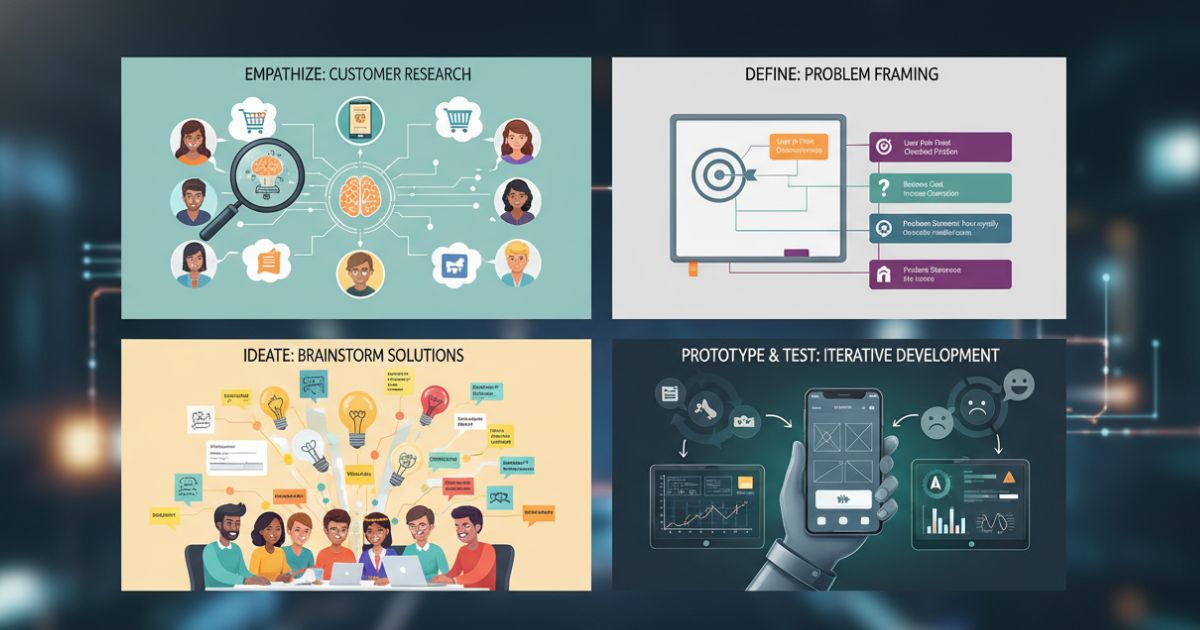
Design thinking helps brands create marketing strategies that connect with real users. These examples show how companies use research, prototypes, and user feedback to improve their campaigns and product experiences.
1. Improving a Landing Page Through User Testing
Key Points:
- Analyze user behavior to find where visitors drop off
- Map the full customer journey to understand friction points
- Create simple wireframes to test layout and content ideas
- Prototype multiple versions of the landing page
- Run A/B tests to compare headlines, visuals, and CTAs
- Collect feedback through heatmaps, recordings, and surveys
- Refine the final page based on real user insights
- Boost conversions with a user-centered, data-backed approach
2. Redesigning Product Packaging Based on Customer Insights
Key Points:
- Gather customer feedback on current packaging challenges
- Use surveys and interviews to identify preferences
- Explore eco-friendly, minimal, or user-friendly design concepts
- Build quick prototypes to test structure and usability
- Test with real customers for clarity, appeal, and convenience
- Refine packaging based on emotional and functional feedback
- Align design with brand identity and sustainability goals
- Increase trust and shelf appeal with human-centered packaging
3. Crafting a More Personalized Email Campaign
Key Points:
- Segment your audience using real user data
- Study user behavior to understand their interests and intent
- Create multiple email variations tailored to each persona
- Prototype subject lines, visuals, and content blocks
- Test emails with a small group before full rollout
- Use A/B results to improve open rates and click-through rates
- Deliver personalized messages that feel relevant and helpful
4. Improving Onboarding for a Digital Product
Key Points:
- Conduct user interviews to understand onboarding struggles
- Map the onboarding flow to identify confusing steps
- Ideate simpler and more intuitive onboarding experiences
- Prototype redesigned walkthroughs, tooltips, or checklists
- Test new flows with real users to identify gaps
- Adjust the process based on user feedback
- Reduce drop-offs and improve first-time user satisfaction
5. Reducing Drop-Off in the Checkout Process
Key Points:
- Study analytics to spot where users abandon checkout
- Interview users to learn what slows them down
- Brainstorm ideas to simplify the process
- Prototype shorter forms or guest checkout options
- Test checkout variations with controlled user groups
- Remove friction points based on direct feedback
- Increase conversions through a smoother, user-friendly flow
6. Strengthening Brand Messaging Through Customer Interviews
Key Points:
- Conduct empathy-driven interviews to uncover real emotions
- Identify common pain points and motivations
- Rewrite messaging based on authentic user language
- Prototype new taglines, value propositions, and content themes
- Test the messaging across ads, landing pages, and emails
- Refine based on how users respond
- Build a clearer, more resonant brand voice
7. Launching a New Feature With Human-Centered Marketing
Key Points:
- Research user needs to validate the new feature idea
- Define the core problem the feature will solve
- Create multiple marketing concepts and story angles
- Prototype visuals, explainer videos, or demo pages
- Test assets with target users for clarity and appeal
- Refine messaging and positioning based on feedback
- Create a launch that truly connects with the audience
Real World Examples of Design Thinking in Action
Airbnb Revolutionizes Storytelling
Airbnb used design thinking to transform its entire marketing approach. Instead of focusing on features, the team chose to deeply understand the emotions and struggles of both hosts and guests. Through empathy interviews and customer journey mapping, they discovered key insights: travelers wanted trust, connection, and a sense of belonging—not just a place to stay.
How Airbnb Applied Design Thinking:
- Conducted empathy interviews with hosts and guests
- Mapped real user journeys to identify emotional pain points
- Designed campaigns around “belonging” and human connection
- Shifted from product-focused marketing to user storytelling
- Used prototyping and testing to refine campaign narratives
- Built a brand message centered around community and trust
Impact:
Airbnb’s “Belong Anywhere” message became one of the most successful human-centric branding examples, proving the power of empathy-driven marketing.
Apple Highlights User Experience
Apple is one of the best-known examples of design thinking in marketing. Instead of focusing on technical specs, Apple focuses on the user experience—simplicity, clarity, and ease of use. This mindset drives not only product design but also every marketing decision.
How Apple Applied Design Thinking:
- Studied user behavior to understand what people value most
- Prioritized simplicity and minimalism in all communication
- Highlighted real user benefits, not complex features
- Used prototypes and user testing to refine product messaging
- Created emotional storytelling around creativity and lifestyle
- Ensured consistency across packaging, ads, retail, and digital touchpoints
Impact:
Apple’s user-centered marketing strategy helped create iconic campaigns and build one of the most loyal customer bases in the world.
Bringing Design Thinking Into Your Team

If you want to bring design thinking into your product marketing process, start small. You don’t need to change everything at once. Begin with one campaign or one problem area. Test the framework, see what works, and adjust as your team learns. This steady approach helps you gradually build a business with a design thinking marketing strategy without overwhelming your team.
To make real progress, create a collaborative and creative environment. Design thinking works best when people from different roles—marketing, product, sales, and customer support—share ideas and look at user problems from multiple angles. This diversity leads to stronger insights and more innovative solutions.
How to Bring Design Thinking Into Your Team:
- Start with one project or campaign
- Use customer insights and user feedback as your foundation
- Encourage open brainstorming and cross-team collaboration
- Build simple prototypes to test new marketing ideas
- Run small experiments and refine based on real user data
- Promote a culture of curiosity, empathy, and continuous learning
- Celebrate small wins to build confidence
By adopting these habits, your team becomes more user-focused, more innovative, and more equipped to create marketing strategies that truly connect with your audience.
Take Your Marketing to the Next Level
Design thinking is a true game-changer for product marketing. When you put the user at the center of every decision, you create campaigns that perform better and feel more meaningful. This human-centered mindset helps you move past assumptions and build marketing experiences that are relevant, intuitive, and easy for customers to connect with. It also strengthens customer engagement and supports long-term brand loyalty.
Ready to begin? Start with small steps. Run an empathy exercise with your team to uncover real customer insights, or host a brainstorming session focused on solving a specific user problem. These simple activities can spark fresh ideas, encourage creative problem-solving, and set the foundation for a more innovative, user-focused marketing workflow.
As you continue, you’ll naturally improve your customer journey mapping, strengthen your user experience strategy, and build a more responsive and human-centered marketing approach that drives results.
FAQs
1. What is design thinking in product marketing?
Design thinking in product marketing is a human-centered approach that focuses on understanding real user needs before creating campaigns or product strategies. It relies on empathy, customer insights, rapid prototyping, and iterative testing to build marketing that truly connects with the audience.
2. Why is design thinking important for marketers?
Design thinking helps marketers avoid guesswork and outdated assumptions. By using real user feedback, empathy mapping, and customer journey research, teams create more relevant, effective, and user-centric marketing campaigns.
3. How does design thinking improve product-market fit?
Design thinking aligns marketing with real customer problems. By testing ideas early, refining messages, and validating concepts with real users, brands build solutions and campaigns that better match what the market actually wants.
4. Can small teams use design thinking?
Yes. Design thinking does not require a large team or big budget. Small teams can start with simple activities like user interviews, quick prototypes, and short A/B tests. The process is flexible and scales easily as the team grows.
5. What tools help with design thinking in marketing?
Useful tools include:
- Empathy maps
- Persona templates
- Customer journey maps
- A/B testing tools
- Prototyping tools (Figma, Canva, Miro)
- Survey platforms
- Heatmaps and behavior analytics
These tools help teams understand users better and validate marketing ideas quickly.