
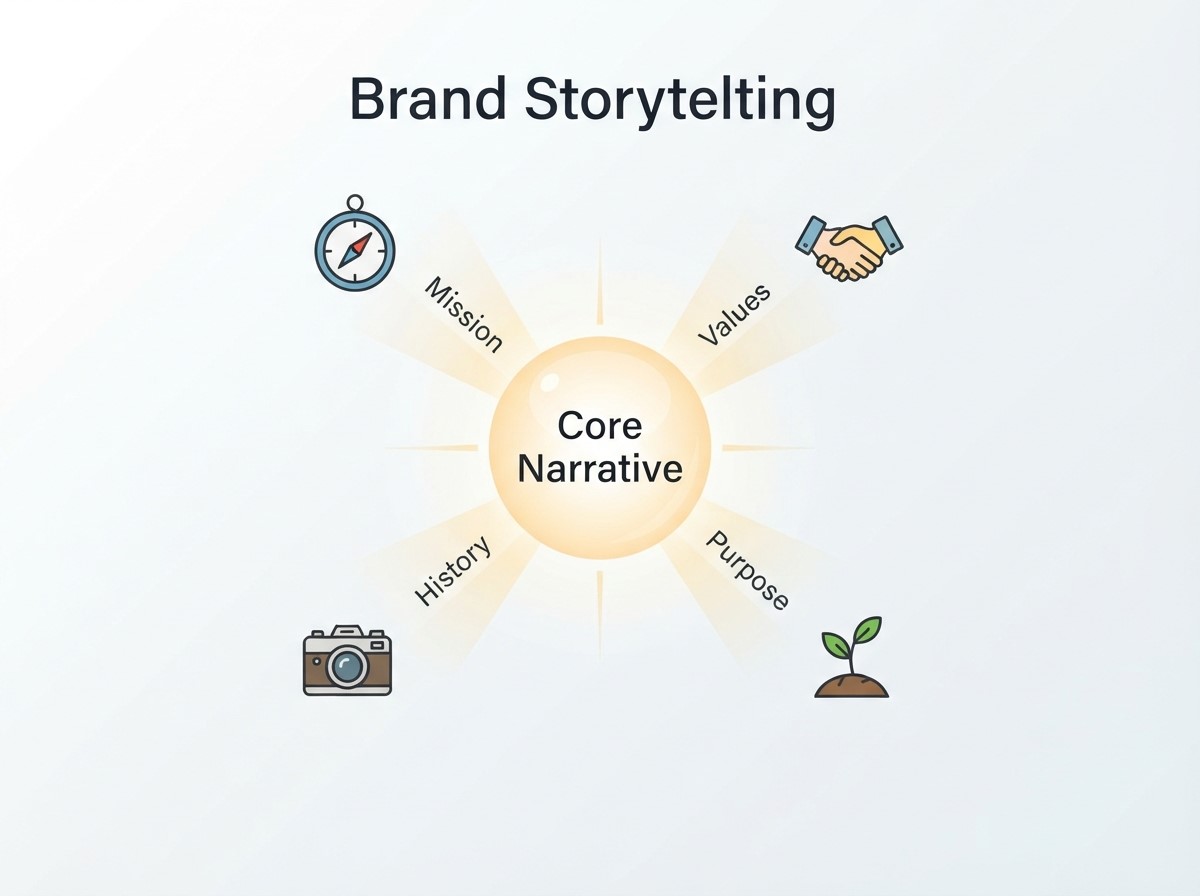
Brand Storytelling is a powerful marketing approach that uses authentic stories to communicate what a business represents, why it exists, and how it creates value for customers. Instead of relying only on product features or promotional messages, storytelling gives audiences a reason to connect with a brand on a more personal level.
Customers are exposed to countless advertisements every day, making it difficult for businesses to capture and maintain attention. A compelling brand story can make marketing messages more memorable by connecting products or services with real experiences, emotions, challenges, values, and customer needs.
What Is Brand Storytelling?
Brand Storytelling is the process of using a structured narrative to communicate a company’s identity, values, purpose, and customer experiences. It goes beyond simply explaining what a company sells. Instead, it helps audiences understand the meaning behind the brand and the problems it wants to solve.
A brand story may include the company’s origin, challenges, achievements, mission, customers, employees, or the reason a particular product was created. The strongest stories are relevant to the audience and supported by genuine brand actions.
Why Stories Are Effective in Marketing
Stories can make information easier to remember because they provide context and meaning. A list of product specifications may explain what a product does, while a story can demonstrate how that product fits into a customer’s life.
For businesses, this creates an opportunity to move conversations away from purely transactional messages and toward experiences that customers can understand and relate to.
The Difference Between Storytelling and Traditional Promotion
Traditional promotion often focuses directly on features, prices, discounts, and calls to action. Storytelling can include these elements, but places them within a broader narrative.
For example, instead of simply saying that a company sells environmentally friendly products, a brand can explain the problem that inspired its founders to develop those products and how customers can participate in a more sustainable approach.
Define Your Brand’s Core Story
A strong brand story starts with a clear understanding of the company’s identity. Before creating campaigns, businesses should determine what they want audiences to remember and what makes their journey meaningful.
The story should be simple enough to understand while being distinctive enough to separate the brand from competitors.
Identify Your Brand Purpose
Brand purpose explains why the business exists beyond making sales. It may involve solving a specific problem, improving an experience, supporting a community, simplifying a process, or making a particular product more accessible.
A clear purpose gives the story direction and helps businesses create consistent messages across different marketing channels.
Highlight the Problem You Solve
Customers are often more interested in solutions than company history alone. A useful brand story should explain the problem that inspired the business and how its products or services address that problem.
This approach helps potential customers recognize their own challenges within the story and understand why the brand’s offering may be relevant.
Show the Human Side of Your Brand
People can connect more easily with people than with corporate statements. Businesses can introduce founders, employees, customers, creators, or partners as part of their storytelling.
Behind-the-scenes experiences, lessons learned, challenges overcome, and customer journeys can make a brand feel more relatable without sacrificing professionalism.
Use Customer Experiences as Part of Your Story
 Customers can become an important part of a brand’s narrative. Their experiences demonstrate how products or services work in real situations and can provide social proof that supports marketing communication. Customer-centered stories should focus on genuine experiences and avoid exaggerating results.
Share Customer Success Stories
A customer success story can explain the customer’s original challenge, the solution they selected, and the experience they had after using a product or service.
For example, a software company can describe how a small business improved its workflow after adopting its platform. This gives potential buyers a practical example instead of an abstract claim.
Encourage User-Generated Content
User-generated content can include customer photos, videos, reviews, social media posts, testimonials, and personal experiences. With appropriate permission, businesses can incorporate this content into their broader brand narrative.
Because the content comes from customers, it can add variety and authenticity to marketing campaigns.
Make Your Story Emotionally Relevant
Emotion can make a brand story more memorable, but businesses should use it responsibly. Effective storytelling does not require dramatic or exaggerated narratives. Even ordinary customer experiences can become meaningful when they address real needs. The objective is to create relevance rather than manipulate emotions.
Focus on Relatable Experiences
A story about learning a new skill, solving a frustrating problem, improving a daily routine, or overcoming a business challenge may resonate with a target audience because people recognize similar experiences in their own lives.
Understanding customer motivations helps businesses choose stories that feel relevant rather than forced.
Create a Clear Narrative Structure
A simple narrative structure can make brand communication easier to follow. The story may introduce a challenge, explain the journey toward a solution, and show the resulting value.
This structure can be adapted for videos, advertisements, blog posts, social media content, presentations, and email campaigns.
Combine Storytelling With Creative Advertising
Creative Advertising can give brand stories a visual and memorable format. Instead of presenting advertisements as direct sales messages, businesses can use characters, situations, narratives, visual sequences, and real customer experiences to communicate their message.
Creative advertising works best when the story supports the product and does not distract from the brand’s purpose.
Use Video Storytelling
Video can combine visuals, sound, dialogue, and emotion to create a complete storytelling experience. Short videos can introduce a brand’s origin, explain a customer problem, show product development, or present a customer journey.
Different formats can be used depending on the platform, including short-form videos, interviews, product stories, documentary-style content, and behind-the-scenes clips.
Use Visual Elements Consistently
Colors, typography, photography, illustrations, graphics, and other visual elements can reinforce a brand’s identity. Consistency helps audiences recognize the brand across different marketing channels.
Visual storytelling should support the message rather than overwhelm it. Every design element should contribute to the overall narrative or customer experience.
Apply Innovative Marketing Ideas to Your Story
 Innovative Marketing Ideas can help businesses present familiar stories in new ways. Innovation does not always require expensive technology. It can involve changing the format, platform, perspective, or interaction style used to communicate the story.
The most useful ideas are those that make the message easier for the intended audience to understand or engage with.
Create Interactive Story Experiences
Interactive content can invite audiences to participate in a brand story. Businesses can use quizzes, polls, interactive videos, surveys, calculators, challenges, or choose-your-own-path experiences.
Participation can make audiences feel more involved than they would be when simply viewing a traditional advertisement.
Use Different Storytelling Formats
One brand story can be adapted into multiple formats. A long-form story may become a short social media video, an email series, an infographic, a podcast discussion, or a customer-focused blog post.
Repurposing stories allows businesses to maintain consistent messaging while adapting the content to different audience preferences.
Connect Stories With Current Conversations
Brands can sometimes connect their stories with relevant cultural, industry, seasonal, or community conversations. However, the connection should feel natural and appropriate.
Joining a conversation simply to gain attention can make a brand appear disconnected. Relevance and authenticity should guide the decision.
Develop Creative Marketing Strategies Around Storytelling
Creative Marketing Strategies help businesses turn individual stories into a consistent long-term marketing approach. Storytelling should not be limited to one campaign. It can become part of the brand’s overall communication system.
A consistent narrative allows customers to recognize recurring themes, values, and experiences.
Build Content Around Core Themes
Businesses can identify several recurring themes that support their brand story. These might include innovation, customer success, education, craftsmanship, community, sustainability, or entrepreneurship.
Each theme can generate different content while remaining connected to the central brand identity.
Use Storytelling Across the Customer Journey
Different stages of the customer journey may require different stories. Awareness content can introduce the problem and brand purpose. Consideration content can demonstrate customer experiences and product benefits. Conversion content can explain why the solution is suitable for a particular need.
After purchase, businesses can share onboarding stories, customer communities, success experiences, and educational content.
Tell Consistent Stories Across Digital Channels
Customers may encounter a brand through search engines, social media, websites, email, advertisements, videos, or third-party platforms. Consistent storytelling helps create a unified brand experience.
Consistency does not mean publishing identical content everywhere. The core message should remain recognizable while the format changes according to the channel.
Website Storytelling
A company’s website can communicate its story through the About page, homepage, product descriptions, case studies, customer testimonials, and blog content.
The website should clearly explain what the company does, who it serves, what problem it solves, and what makes its approach distinctive.
Social Media Storytelling
Social media provides opportunities for frequent storytelling through posts, short videos, live sessions, customer features, polls, and behind-the-scenes content.
Businesses can use social platforms to show the people and processes behind their products rather than focusing exclusively on promotional announcements.
Email Storytelling
Email allows brands to develop stories over multiple messages. A welcome sequence can introduce the company’s purpose, explain its journey, share useful customer experiences, and gradually introduce products or services. This approach can help build familiarity before making a direct sales offer.
Measure the Impact of Brand Storytelling
 Storytelling should support measurable marketing objectives. Businesses can evaluate whether their content is increasing engagement, improving awareness, generating leads, or supporting customer retention.
The specific metrics should match the campaign’s purpose rather than relying on a single measurement.
Track Engagement
Engagement metrics may include video views, watch time, comments, shares, saves, email clicks, page engagement, and social interactions. These numbers can indicate whether audiences are responding to the content.
However, engagement alone does not necessarily demonstrate business success. It should be considered alongside traffic, leads, conversions, and customer behavior.
Monitor Conversion and Retention
Businesses can track whether storytelling content contributes to website visits, inquiries, registrations, purchases, repeat purchases, or other desired actions.
Customer retention can also provide useful information. If storytelling strengthens relationships and improves customer experience, it may contribute to longer-term engagement.
Common Brand Storytelling Mistakes to Avoid
One common mistake is making the brand the only focus of every story. Customers usually want to understand how the story relates to their own needs. Effective storytelling should therefore connect the brand’s experience with customer problems and outcomes.
Another mistake is creating stories that sound unrealistic or overly polished. Audiences may respond better to authentic experiences, including challenges and lessons learned. Businesses should also avoid changing their core message constantly. A brand can tell many different stories while maintaining consistent values and positioning.
How Brand Storytelling Supports Customer Retention
Brand storytelling can continue after a customer makes a purchase. Businesses can use stories to educate customers, celebrate their experiences, introduce new products, and demonstrate ongoing value.
Post-purchase storytelling can help customers feel connected to the brand rather than treating the relationship as a completed transaction.
Build a Community Around Shared Values
Customers who identify with a brand’s purpose may be interested in participating in a broader community. Businesses can encourage this through online communities, customer events, educational content, and shared experiences. A community gives customers additional reasons to remain engaged with the brand.
Celebrate Customer Milestones
Businesses can recognize customer achievements, anniversaries, project successes, or community contributions when appropriate and with permission.
These moments can become meaningful stories that reinforce the relationship between the customer and brand.
Conclusion
Brand Storytelling gives businesses a way to communicate their purpose, values, experiences, and customer impact through memorable narratives. Instead of relying entirely on promotional messages, companies can use stories to make their communication more relevant and human.
Combining storytelling with Creative Advertising, Innovative Marketing Ideas, and Creative Marketing Strategies can create engaging campaigns across websites, social media, email, video, and other channels. Customer experiences can also strengthen the story by demonstrating how a product or service creates practical value.
Frequently Asked Questions
1. What is Brand Storytelling?
Brand Storytelling is a marketing approach that uses narratives to communicate a company’s purpose, values, experiences, and customer impact. It helps businesses create meaningful connections between their brand and target audience.
2. Why is Brand Storytelling important?
It can make marketing messages more memorable, communicate brand personality, demonstrate values, and help customers understand why a business exists. It can also support stronger customer relationships when the story is authentic and relevant.
3. How can Brand Storytelling attract customers?
Businesses can use stories to address customer problems, explain their purpose, demonstrate real experiences, and communicate meaningful benefits. Relevant stories can attract people who identify with the problem, values, or experience being presented.
4. Can Brand Storytelling improve customer retention?
It can support retention by creating ongoing communication and stronger relationships with customers. Stories about customer experiences, community activities, education, and brand development can provide reasons for customers to remain engaged.
5. What is Creative Advertising in Brand Storytelling?
Creative Advertising uses original concepts, visuals, narratives, videos, and experiences to communicate a brand message. When combined with storytelling, it can turn a promotional message into a more engaging narrative.
6. How can businesses use Innovative Marketing Ideas for storytelling?
Businesses can use interactive content, user-generated content, video series, podcasts, quizzes, live events, digital experiences, and storytelling campaigns. The chosen approach should match the target audience and brand objectives.
7. What are Creative Marketing Strategies for storytelling?
Creative Marketing Strategies may include customer storytelling, founder stories, behind-the-scenes content, interactive campaigns, community stories, educational narratives, and multi-channel content campaigns.
8. Should every brand have a story?
Most businesses can benefit from clearly communicating their purpose, customer value, and identity. However, the story does not need to be dramatic. Simple, genuine experiences can provide useful material for brand communication.
9. How can I make my brand story authentic?
Use genuine experiences, accurate customer stories, consistent messaging, and realistic claims. Avoid inventing customer experiences or exaggerating results. The story should reflect the company’s actual actions and values.
10. How do I measure Brand Storytelling success?
You can monitor engagement, website traffic, social interactions, email performance, leads, conversions, customer feedback, repeat purchases, and retention. The most relevant metrics depend on the specific objectives of the storytelling campaign.